
ROME, ITALY: THE ULTIMATE TRAVEL GUIDE TO THE ETERNAL CITY
They say that all roads lead to Rome, and it certainly feels that way whenever I’m back in Italy. It’s the grandest Italian city, and an easy place to return to. Rome is a historic marvel that never gets old, the perfect blend of ancient wonders, busting piazzas and La Dolce Vita energy. It’s a must for first-time visitors, and a destination worth repeating if you’ve been before. Below is my complete travel guide to Rome including the best historic sights, places to visit, viewpoints, Rome photo locations, restaurants, gelato shops, best Rome hotels, travel tips and more.
This post contains affiliate links. When you click these links I may get a small commission that won’t cost you anything, but it does help me run this website.
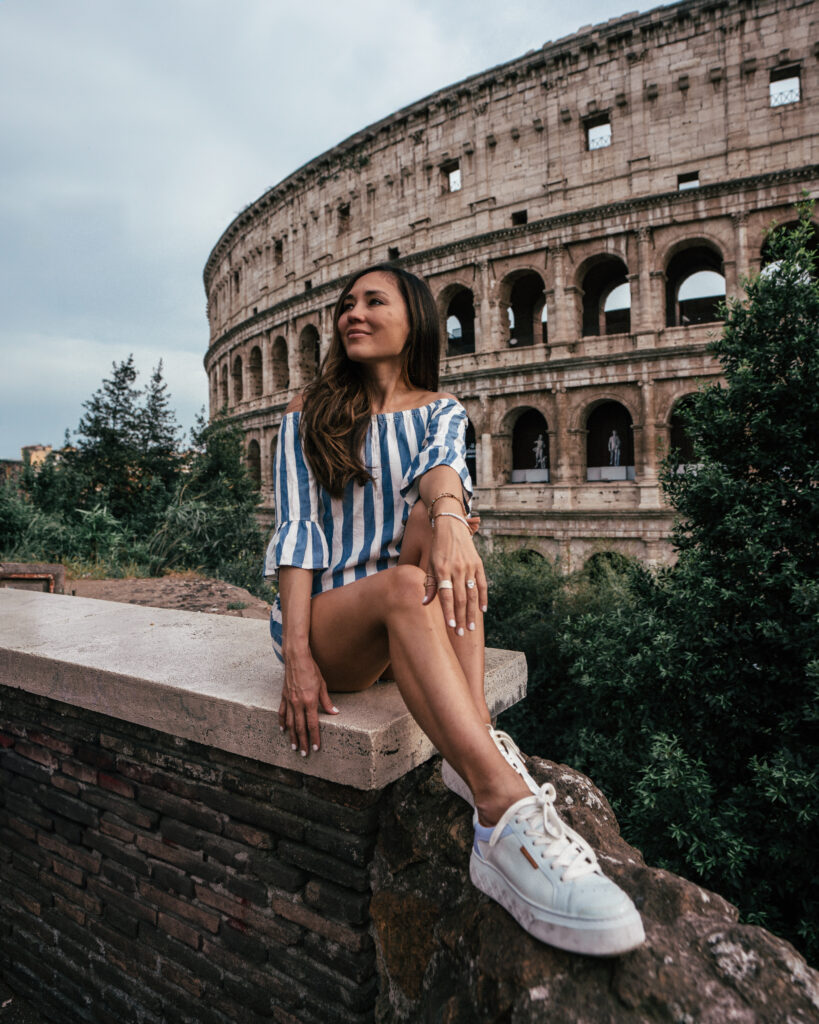
Absolutely iconic views of the Colosseum from Largo Gaetana Agnesi.
ROME TRAVEL TIPS
- CURRENCY – The official currency in Italy is the Euro. While most places take credit card, it’s always handy to have some cash on hand for smaller purchases, cabs, etc.
- DINNER RESERVATIONS – Make dinner reservations for high priority restaurants, especially in high season.
- OFFLINE GOOGLE MAP – Download an offline Google map of Rome to help navigate the city in the event you have no wi-fi or have trouble connecting to cell service.
- STAY CONNECTED – Most hotels and most restaurants have free wifi, but for 24/7 connection I recommend purchasing an eSIM before flying to Italy. I use Holafly – it’s affordable, and only takes a few seconds to install. The eSIM plans for Italy are linked here (use code BUCKETLISTBUMS for 5% off).


Piazza Navona is my favorite square in Rome.
WHEN TO VISIT ROME
- APRIL, MAY, SEPTEMBER, OCTOBER – Shoulder season is the best time of the year in Rome. Crowds can’t be avoided, but it won’t be as busy as summer, temperatures are more manageable and hotel prices a bit more reasonable.
- JUNE-AUGUST – This is the busiest time of the year in Rome. If you visit in summer, book everything well in advance including tickets historic sites, tours, lodging and restaurant reservations.
- NOVEMBER-MARCH – Hotel prices are more affordable in low season when crowds thin out, but you risk cold and rainy weather this time of the year.

Stopped by The Pantheon around 7 AM, and it was completely serene.
HOW MANY DAYS IN ROME
For first time visitors, four days is the ideal amount of time for the main sights in Rome. Prepare for early mornings and long days if you want to cover most of the places included in this travel guide. It’s a busy city – plan your mornings around the more popular tourist attractions.


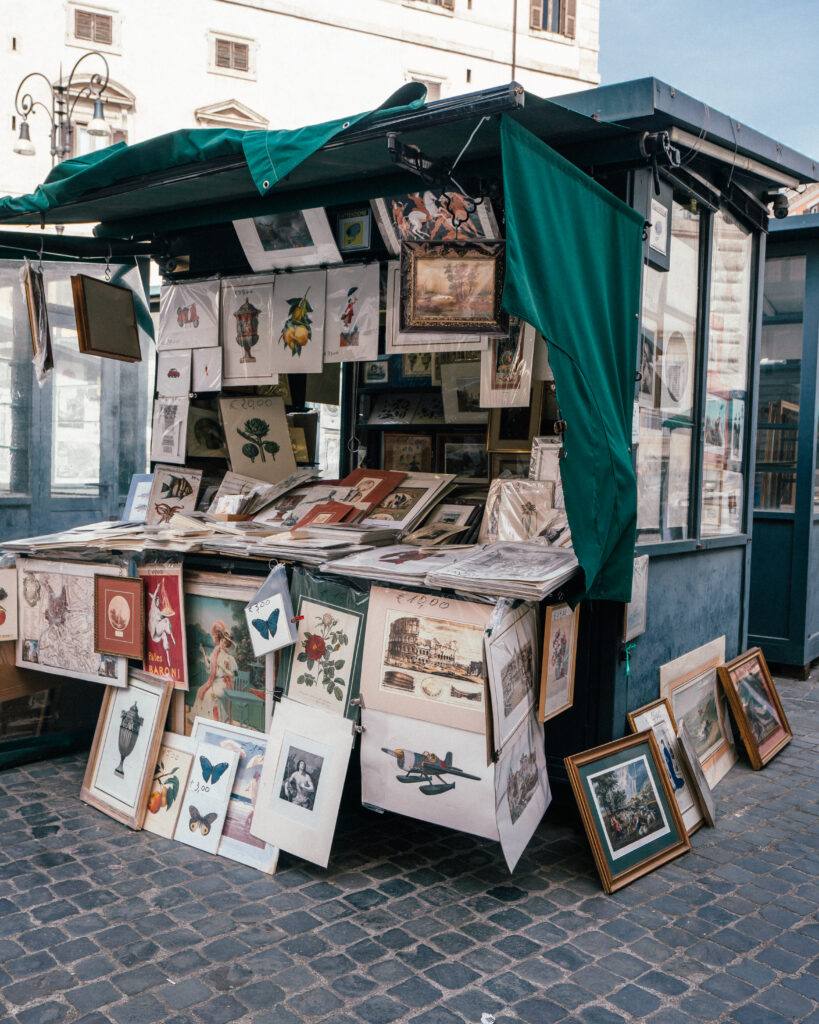
Mercatino del Libro is a collection of outdoor stalls that sell antique books, vintage prints and old maps.
PLACES TO VISIT IN ROME
ARCO DEGLI ACETARI
This lovely little courtyard sits tucked away behind an arched passage near the Campo de’ Fiori. Medieval orange buildings accented by pale green vines and olive trees surround a cobbled square. This is a hidden gem that’s a short walk from the Piazza Navona.
BASILICA DI SANTA MARIA MAGGIORE
This is the largest Marian church in the world, and one of four papal basilicas in Rome. Basilica di Santa Maria Maggiore dates back to the 5th century, a mix of Roman, medieval and Baroque architecture styles. The church is a popular pilgrimage spot for Catholics, home to several religious relics including the Salus Populi Romani. Tourists can visit the church, entry is free.
BATHS OF CARACALLA
The sprawling Baths of Caracalla date back to 216 AD. In its heyday, the baths were home to libraries, gyms, gardens and baths surrounded by soaring columns, sculptures, marble and mosaics. What remains today are freestanding ruins, some walls rising to 130 feet. There are still floor mosaics in tact, as well as underground tunnels, a church and a museum.
CASTEL SANT’ANGELO
Castel Sant’Angelo is the striking fortress-like structure that sits at the end of St. Angelo Bridge. It’s gone through many iterations over the years, originally a grand mausoleum before evolving into a medieval fortress, a tomb and national museum. It dates back to 139 AD, and was once an escape route for the Pope – a secret elevated passageway connects Castel Sant’Angelo directly to Vatican City.
COLOSSEUM
The Colosseum was crowned one of the New Seven Wonders of the World back in 2007, more than 1,900 years after its completion in 80 AD. It’s the largest ancient amphitheater ever constructed, able to hold 50,000 people. It was originally used as a public arena for gladiator fights, public executions and theatre performances. Today, the Colosseum is one of Rome’s most popular tourist attractions. To visit, a timed entry ticket is required. Book in advance and nab the first entry of the day.
LARGO GAETANA AGNESI
Largo Gaetana Agnesi is my favorite location for photos of the Colosseum. The elevated terrace sits high above the ground, perfectly mid-level to the historic ruins. It’s located across the street from the Colosseum. This is a public space and free to visit. Best to visit early in the morning before crowds show up for selfies.
MERCATINO DEL LIBRO
This historic open-air market is an absolute gem that sits tucked away on Piazza Borghese. The collection of old-world green metal stalls that sell rare books, old prints, weathered maps and antique biblio-goods conjure feelings of nostalgia.
MONUMENT OF VITTORIO EMANUELE II
The name might not be familiar, but the Monument of Vittorio Emanuele II is the first historic site most tourists see when they arrive in Rome by taxi. The sprawling structure looks wildly historic, but was actually commissioned at the turn of the 19th century. It overlooks the Piazza Venezia and features a sprawling colonnade, the Altar of the Fatherland, a massive statue of King Victor Emmanuel II and epic fountains depicting the Adriatic and Tyrrhenian Seas.
PALAZZO COLONNA
This is one of the oldest and largest private palaces in the city. The stunning Palazzo Colonna has been home to the same noble family for more than eight centuries. And while the exterior architecture is a bit understated, the inside is utterly dazzling. The Great Hall is particularly incredible, an exquisite Baroque hallway filled with ceiling frescoes, gold details, gilded mirrors and art pieces. Tourist access is limited to Friday and Saturday mornings only. Advance tickets are available, but can also be purchased in person.
PALAZZO DORIA PAMPHILJ
This is another grand palace occupied by a noble family. Palazzo Doria Pamphilj is famous for its art collection that includes pieces from Titian, Raphael and Caravaggio. The prettiest space in the palazzo is the Gallery of Mirrors, a dazzling corridor inspired by the Hall of Mirrors at Versailles. The gallery uses light and gold to create the illusion of infinite light throughout the space that is lined with Venetian gold mirrors, statues, gilded stucco and vaulted ceiling frescoes. Advance tickets not required, but recommended.
PANTHEON
Located on the Piazza della Rotonda, the Pantheon is a truly awesome structure with an oculus located at the center of the structure. It was first built as a temple to the gods almost 2,000 years ago before becoming a church in 609 AD. Today, it’s the resting place for some of Italy’s most notable historic figures including the painter Raphael, architect Baldassare Peruzzi, composer Arcangelo Corelli, King Vittorio Emanuele II and his family members. Notable times to visit: morning to avoid the massive crowds, noon for soft light beaming through the oculus and golden hour for warm tones on the interior marble. The Pantheon is no longer free to visit, and requires a paid ticket.
PIAZZA CAMPO DE’FIORI
Campo de’Fiori is one of the city’s oldest open-air markets. Stalls that sell fresh food, flowers, produce and Italian housewares fill the bustling piazza and surround the iconic statue of Giordano Bruno. The market takes place Monday to Saturday, from 7 AM to 2 PM.
PIAZZA NAVONA
This is my favorite piazza in Rome. The long expansive square is an oval shape surrounded by colorful Roman buildings, the Church of Sant’Agnese in Agone and the Palazzo Braschi. Three grand Baroque fountains sit in the piazza – Fountain of the Four Rivers, Fountain of the Moor and Neptune Fountain. It’s an absolute vibe to sit at an outdoor cafe on the square and soak in the energy of the outdoor painters, street performers, tourists and locals.
PIAZZA DEL POPOLO
This is another elliptical piazza that once served as the north entrance to Rome. Piazza del Popolo is a large square, and the most iconic site is the “twin churches” Santa Maria in Montesanto and Santa Maria dei Miracoli.
PONTE SANT’ANGELO
This historic bridge crosses the Tiber River connecting the historic center of the Eternal City to Castel Sant’Angelo. Ponte Sant’Angelo is constructed from travertine marble lined with 10 massive angel sculptures Gian Lorenzo Bernini. It’s a common to cross the pedestrian bridge on the walk to Vatican CIty.
ROMAN FORUM + PALATINE HILL
Located directly across from the Colosseum, the Roman Forum is the natural place to visit after the Colosseum, but if you have two free mornings in Rome, I would instead visit the Roman Forum on your second morning right when it opens. It’s one of my favorite historic settings in the city, and it’s best experienced without mass crowds. This place is incredible, home to the ruined remains of historic temples and shrines. A few highlights include the Temple of Saturn, Temple of Vesta, Temple of Caesar and Arch of Titus. Note that bundled tickets for the Colosseum and Roman Forum are available if you wish to visit the same day.
SPANISH STEPS
The dreamy Spanish Steps overlook Piazza di Spagna in the Rione Campo Marzio neighborhood of Rome. The Italian Baroque curvy staircase was designed by Francesco de Sanctis in 1725. It’s one of the most romantic settings in the city, and if you time your visit right, blooming pink azaleas surround the steps in the spring. Several movies were filmed here including Roman Holiday, Mission Impossible, The Talented Mr. Ripley and Eat Pray Love.
TRASTEVERE
The neighborhood of Trastevere feels like the setting of a small Italian town. A labyrinth of cobbled lanes, little piazzas and charming alcoves surround the Basilica of Santa Maria. Life here moves a bit slower than the rest of the city. Mornings are very quiet, but it’s a vibe in the evenings when the outdoor tables fill up at the charming trattorias.
TREVI FOUNTAIN
Trevi Fountain is one of the most iconic sites in Rome, and its popularity has skyrocketed in recent years thanks to social media. The 18th century Baroque fountain sits in the heart of the historic center, and the sheer scale of the fountain is pretty incredible. This used to be a quiet place that was empty at sunrise, but those days are long gone. The fountain is busy all hours of the day.
THE VATICAN
Vatican City is the world’s smallest independent state, and it’s located in Rome, a short distance from the Tiber River. It requires almost a full day to really see and appreciate everything including St. Peter’s Square, the Vatican Museums, the Sistine Chapel and St. Peter’s Basilica. Book a timed ticket for a tour of the Vatican Museums well in advance.
VIA DEL GOVERNO VECCHIO
Rome’s historic district is filled with several picturesque streets, lanes and alleys, but Via del Governo Vecchio is particularly lovely. The charming orange and yellow facades of this storied street are home to boutiques, restaurants, gelato shops, bookstores, pizzerias and wine bars. One of the most scenic walks in the city.
VIA GIULIA
Another lovely street in the historic center that dates back to the 16th century. Via Giulia stretches for a kilometer, but it’s much quieter than Via del Governo Vecchio. It’s lined with soaring palaces, churches and residences instead of boutiques, wine bars and restaurants. The most scenic stop on the street is the Arco di Farnese, a bridge and archway designed by Michelangelo.
VILLA BORGHESE GARDENS
The Villa Borghese Gardens occupy almost 200 acres in the historic center of Rome. It’s home to manicured gardens, peaceful fountains and even the Lake of Aesculapius. The gardens are free entry to the public.

The Spanish Steps.
PLACES TO STAY IN ROME
Set in a 19th century crescent shaped palace, Anantara Palazzo Naiadi is one of Rome’s many luxury hotel options. The white marble neoclassical building overlooks the Piazza della Repubblica set in the historic center of the city. More than 200 rooms span the main palace and the Clementine wing, a mix of rooms and suites that boast high ceilings, floor-to-ceiling windows, timber beams and marble bathrooms. For fabulous panoramas, visit the pool and rooftop terrace.
Borghese Contemporary is another hotel set in a former palace, this one located across from the iconic Palazzo Borghese. The boutique property houses just 24 rooms and suites that are understated, but elegant. The property is walking distance to several important sites in Rome including the Spanish Steps.
A former 16th century nunnery and annex to the Palazzo Borghese, the charming Hotel Vilon has since transformed into an elegant retreat of 18 rooms and suites. The setting is idyllic with private views of the palazzo gardens, as well as terraces draped in growing greenery. Film set designer Paolo Bonfini designed the rooms that have been filled with Art Deco pieces, and feature high ceilings, wood floors and soothing color palettes that vary by room.
Hoxton Rome is one of the more hip hotel stays in Rome. It’s a relatively new property that opened in 2021. The design is vintage cinematic, but everything feels new and modern. Details include parquet floors, velvet sofas, lacquered timber, bespoke pieces and Murano glass chandeliers.
INTERCONTINENTAL ROME AMBASCIATORI PALACE
Intercontinental Rome Ambasciatori Palace is another sprawling hotel set inside a restored palazzo from 1900. It was originally built as housing for visiting diplomats before transforming into the American Embassy Library. In 2023, it opened its glorious doors as a hotel property. There are 160 rooms and suites – very clean, airy and modern. This is a great hotel option that still feels fresh and new.
This four-star boutique property sits in a 16th century Renaissance Palace at the Piazza Navona. The design of the rooms isn’t my favorite, but everything is clean, high-end and spacious. Martis Palace Hotel offers an intimate stay with only 26 guest rooms and suites.
Nerva Boutique Hotel sits in a little 19th century building in the historic Monti neighborhood of the city, between the Colosseum and Piazza Venezia. A stay here feels very homey with 20 unique rooms and suites that offer Italian furnishings, wood flooring, Italian fabrics and marble bathrooms. This is a family-run hotel. Location is ideal – Trevi Fountain, the Pantheon and Piazza Navona are all walking distance.
Yet another palace stay option in Rome. Palazzo Delle Pietre is set in a 15th century palace that feels like stepping into a museum. A historic collection of Renaissance Roman artifacts are scattered throughout the property that houses 10 meticulously transformed luxury apartments. Each apartment is unique, and the spaces are amazing – wood beams, fresco ceilings, marble columns, high ceilings and more. This is one of the best places to stay in Rome.
Portrait Roma is a five-star boutique property located on the luxury shopping street Via Condotti above the Ferragamo flagship store. The coveted 14 studios and suites drip in La Doce Vita luxury featuring lovely terraces, spacious bedrooms, marble bathrooms and vintage art and photos. This place is a splurge, but a truly exclusive stay in Rome.
RADISSON COLLECTION HOTEL, ROMA ANTICA
Similar to its sister property in Venice, the Radisson Collection Hotel, Roma Antica sits in a palazzo that has been completely restored, retaining its historic bones but transforming the space into a modern luxury retreat. The 84 rooms and suites feel very fresh and new, thanks to the 2024 hotel opening. Guest are treated to hard wood floors, Carrara marble bathrooms, Fornasetti wallpaper, rain showers and more. This is a fabulous hotel option in Rome.
Rome EDITION is another great luxury option that feels like a hip stay in an old city. Rooms almost have a minimalist 70s vintage feel to them thanks to the oak panel walls and wood floors. The color palette is a mix of neutrals and whites in the bedrooms and brass fixtures in the bathrooms – everything feels very comfortable and high-end. The hotel sits in an old 1940s bank building, a 10-minute walk from Trevi Fountain.
For over-the-top luxury, look no further than Six Senses Rome. The five-star hotel resides in the 15th century Palazzo Salviati Cesi Mellini, walking distance to both Trevi Fountain and the Pantheon. This urban oasis houses 96 rooms and suites that expertly blend historic Rome with modern creature comforts designed with traditional Cocciopesto plaster and Travertine limestone. The rooms are beautiful – a true luxury stay.
St. Regis Rome is one of the city’s most iconic hotels. Originally know as the Grand Hotel, the property first opened its doors in 1894 as the city’s first luxury hotel. The rooms feel very much like a palace thanks to the high ceilings, wall moulding, bright whites and neutrals, floor-to-ceiling drapes, Italian art prints and gold headboards.
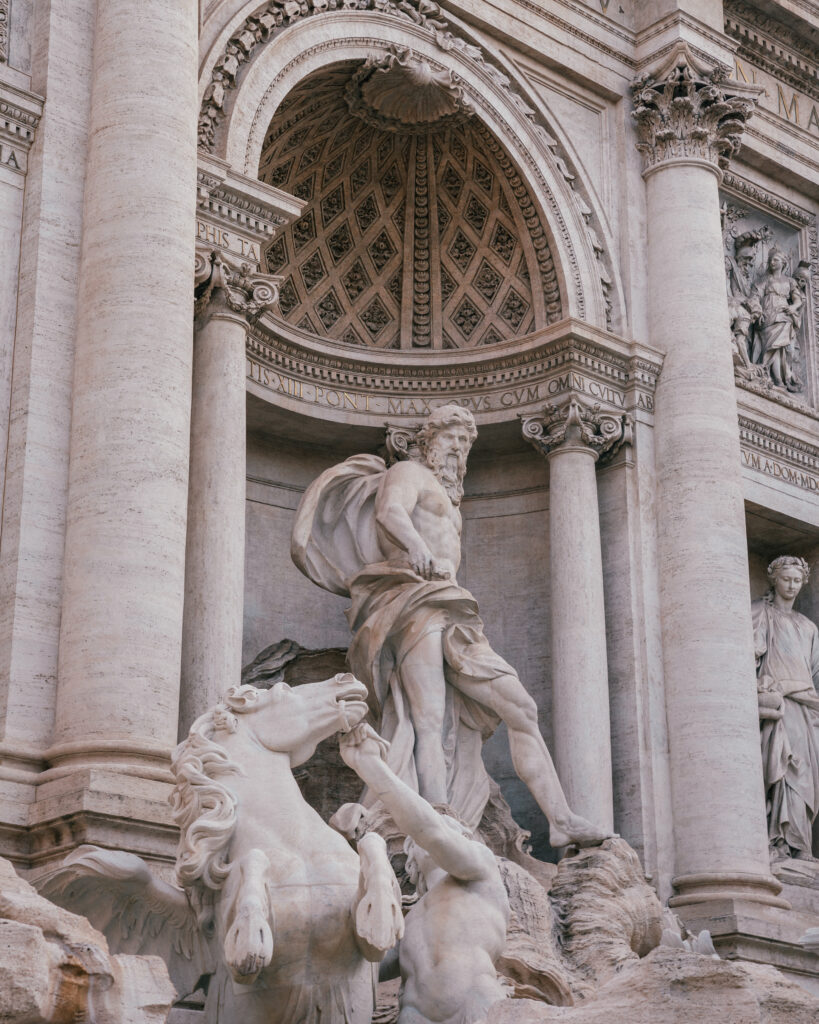


Trevi Fountain.
ROME RESTAURANTS
- CANTINA E CUCINA – fresh pasta
- CIPASSO – fresh pasta
- FIORE – pizza
- HEDERA OSTERIA CONTEMPORANEA – fresh pasta
- LA NUOVA PIAZETTA – fresh pasta
- NANNARELLA – fresh pasta
- OSTERIA DA FORTUNATA – fresh pasta
- OTELLO – fresh pasta
- PANE E SALAME – sandwiches
- PICCOLO BUCO – pizza
- PIZZERIA DELLA MADONNA DEI MONTI – pizza
- RISTORANTE PIZZA FORUM – pizza
- ROSCIOLI SALUMERIA CON CUCINA – fresh pasta
- TONNARELLO | PAGLIA – fresh pasta
- VECCHIA ROMA – fresh pasta


Roscioli Salumeria con Cucina serves some of the best fresh pasta in Rome.
BEST ROME GELATO
- BRIVIDO GELATERIA
- COME IL LATTE
- FASSI GELATERIA
- FATAMORGANA
- FIORDILUNA
- GELATERIA DELLA PALMA
- GELATERIA VALENTINO
- GELATO DEL TEATRO
- GIOLITTI
- GUNTHER
- LA GOURMANDISE
- NEVE DI LATTE
- OTALEG

Exploring the city’s Trastevere neighborhood.
BEST ROOFTOP BARS IN ROME
- CIELO ROOFTOP – view of the Spanish Steps, Piazza di Spagna and Rome skyline
- THE COURT BAR – view of the Colosseum
- ETERE ROOFTOP – view of terracotta rooftops, Mausoleum of Augustus and Rome skyline
- TERRAZZA BORROMINI – view of Piazza Navona, terracotta rooftops and Rome skyline
- TERRAZZA LES ETOILES – view of Vatican City and Castel Sant’Angelo
- ZUMA – view of the Via dei Condotti and Spanish Steps

GET AROUND ROME
Rome is a large city, but most tourists stay within the historic city center where most places are walkable. It’s a lot of walking, but there’s always something to eat or see on your journey from one place to the next. Both taxis and Ubers are available for longer distances.


Castel Sant’Angelo.
GET TO ROME
- FLIGHT – Rome is home to the Leonardo da Vinci–Fiumicino Airport (FCO) that connects the city to destinations within Italy, as well as dozens of cities around the world.
- RIDE SHARE – Ubers are available within Rome, and it’s a 45-minute drive from the airport to the historical center of the city.
- TAXI – Taxis are also available at the airport for a fixed rate into the city center.
- TRAIN – Train is a popular way to travel in Italy, and the central Roma Termini station connects Rome to cities throughout Italy.

Vintage vibes in Rome.